
Darby
25 Kilometres of Prospective Strike. Next Door to Cigar Lake.
The Darby Project is a 70/30 joint venture operated by Cosa and held in partnership with Denison Mines, entered as part of the two companies' January 2025 strategic collaboration.
Located just 10 kilometres west of the Cigar Lake Mine, Darby is interpreted to contain more than 25 kilometres of prospective conductive strike length.
Cosa’s reinterpretation of historical data has flagged the 95B, 96D, and 4A conductive trends as initial high-priority exploration targets within the Darby Project. Historical drilling on 95B defined more than 25 metres of unconformity topography where a package of metasedimentary rocks hosting graphitic brittle structure, hydrothermal alteration, and weak uranium mineralization lies in fault contact with underlying granitic rocks.
Three holes were completed at Darby to test priority targets at the Charlie, Gamma, and Delta trends identified by Cosa’s 2025 core relogging and reinterpretation program
(see Cosa’s news release dated May 06, 2026).
Charlie Trend
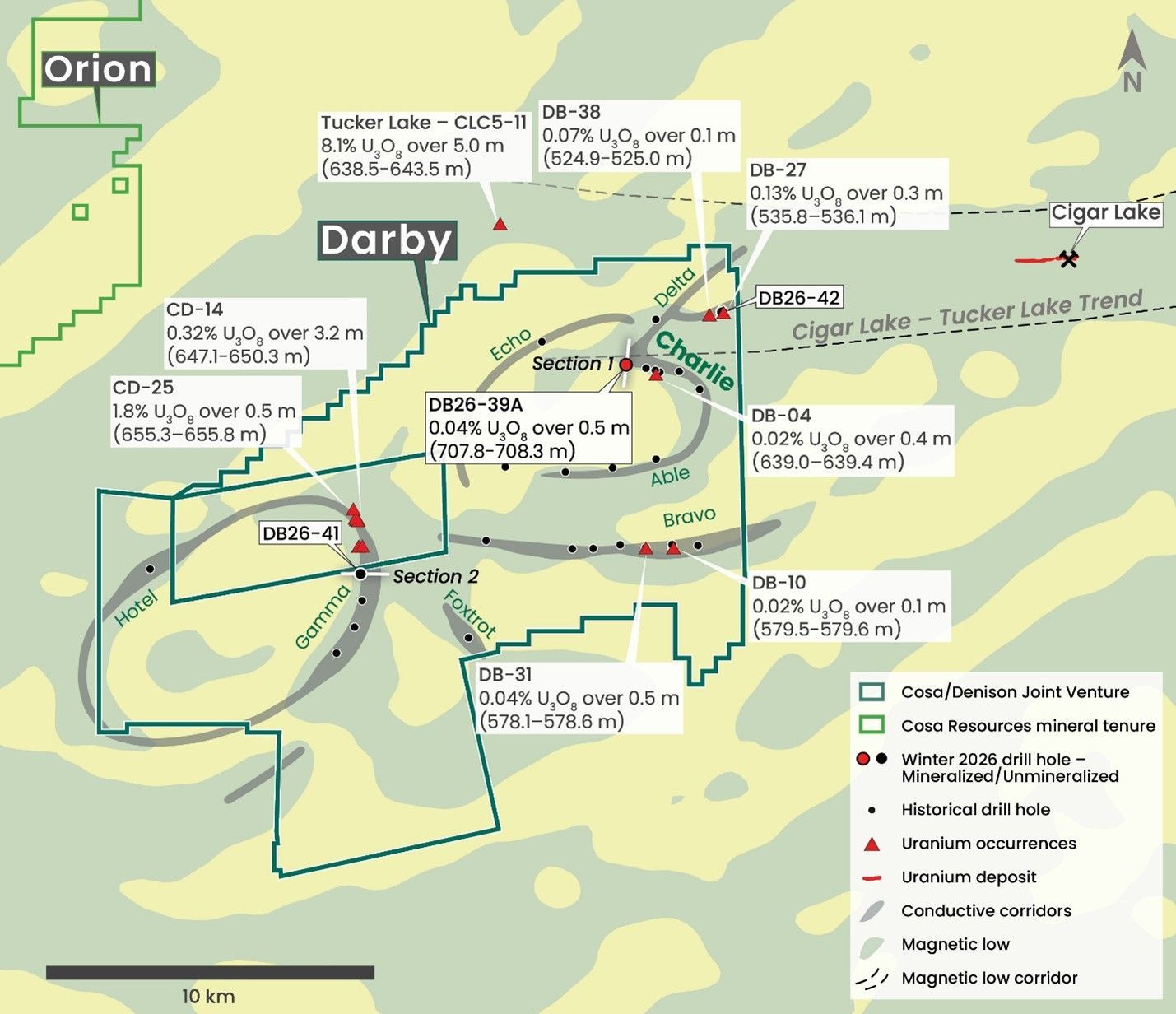
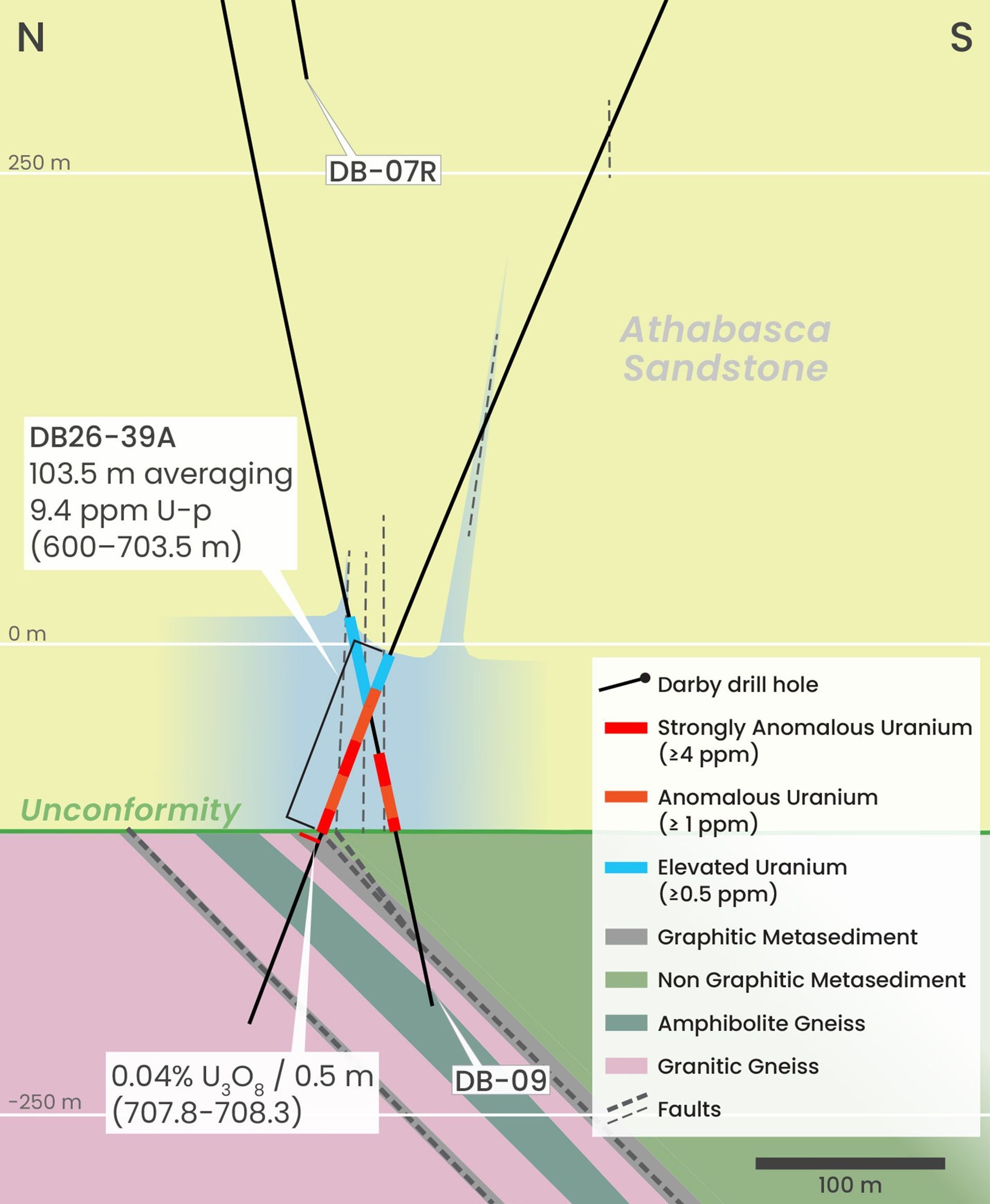
Winter drill hole DB26-39A followed up basement structure and anomalous1 sandstone uranium content in historical drill hole DB-09 and successfully intersected the targeted graphitic unit at the unconformity. DB26-39A intersected very strongly anomalous uranium content in the sandstone, averaging 5.6 ppm over 103.5 metres (600.0 – 703.5 metres) including a subinterval averaging 9.5 ppm over 53.5 metres (650.0 – 703.5 metres) in the basal sandstone (Figures 2 and 3). These values exceed the strongly anomalous results of DB-09 which intersected 2.0 ppm uranium over 116.8 metres (543.2 – 660 metres). DB26-39A also intersected 0.04% U3O8 over 0.5 metres (707.8 – 708.3 metres), which is the second intersection of weak uranium mineralization on trend. Several high priority follow up targets remain untested at Charlie.
Gamma Trend
Winter drilling results significantly upgraded the Gamma trend and generated several follow-up targets.
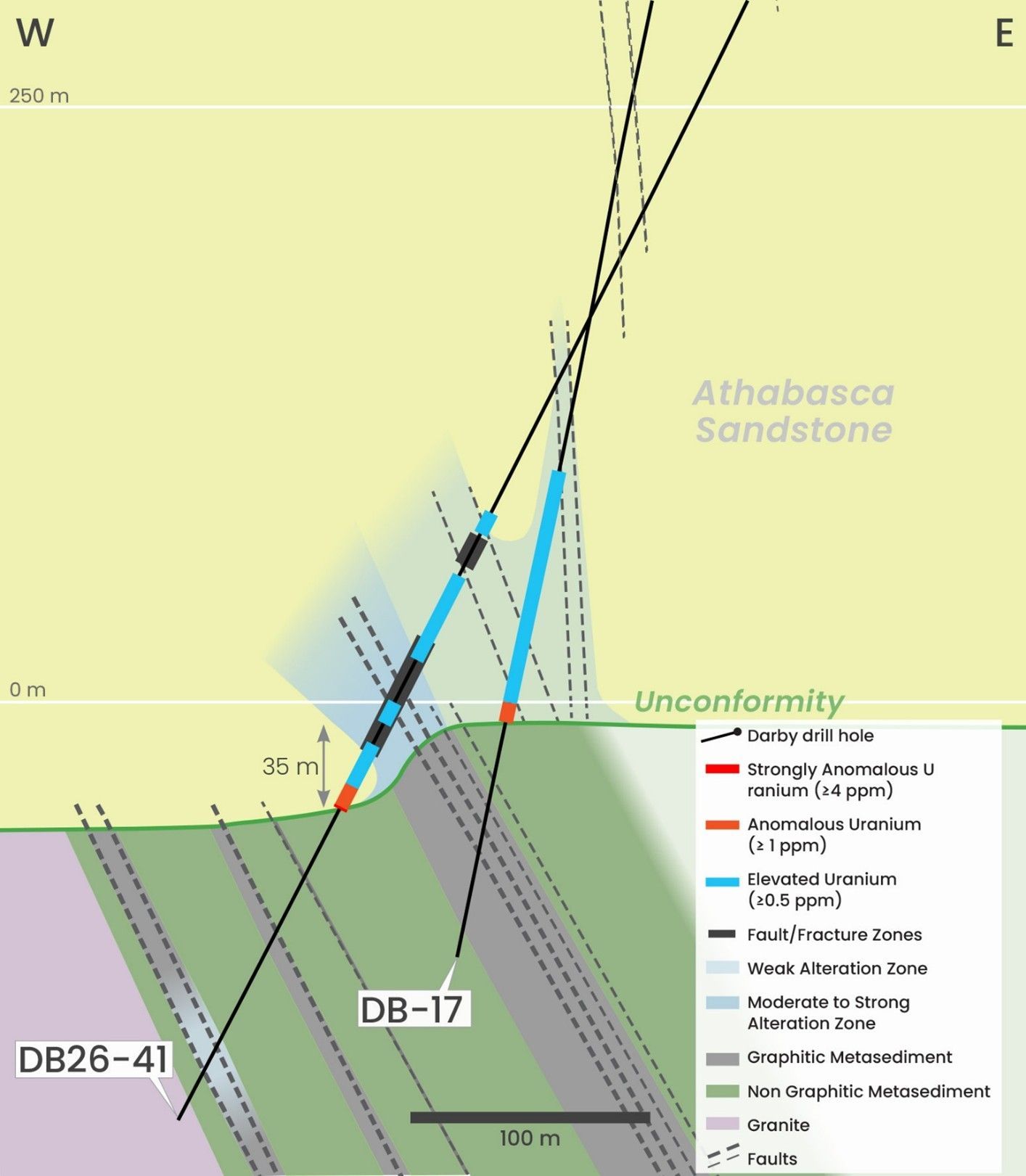
The Gamma trend was prioritized for drilling based on elevated to anomalous sandstone uranium content proximal to graphitic basement faults in historical drill hole DB-17, and the presence of numerous intersections of uranium mineralization along trend north of Darby (Figures 2 and 4). DB26-41 targeted the DB-17 basement faults at the unconformity.
DB26-41 intersected two decametre-scale intervals of faulting and alteration in the lower sandstone, elevated to anomalous sandstone uranium content, and identified 35 metres of unconformity relief relative to DB-17. Basement rocks are graphitic and non-graphitic metasediments overlying granite. Graphitic fault zones intersected 30 to 124 metres below the unconformity are generally thicker than those in DB-17 and some are enveloped by metre-scale zones of hydrothermal alteration.
DB26-41 and DB-17 define a highly prospective geological environment which includes an approximately 150-metre-wide corridor of graphitic basement faulting, zones of hydrothermal alteration and faulting in the sandstone and basement, and uranium enrichment in the sandstone. The prominent unconformity relief is similar to unconformity offsets from reverse faulting present at several Athabasca uranium deposits, most notably at Cameco’s McArthur River mine.
Delta Trend
DB26-42 followed up historical drill hole DB-27 (Figure 2), which intersected a 48-metre interval of continuously anomalous uranium content in the sandstone above graphitic basement faulting. DB26-42 targeted the DB-27 basement faulting at the unconformity and did not intersect any significant results; geochemical results remain pending. Several kilometres of prospective strike length remain at Delta.
Planned Drilling
Drilling at Darby is planned to comprise up to 2,000 metres at the Gamma and Bravo trends (Figure 2). Drilling at Gamma will follow up Cosa’s winter 2026 drill program which intersected a broad zone of structure with significant unconformity offset, alteration, and elevated to strongly anomalous uranium geochemistry on trend with historical uranium mineralization (Figures 2, 3). Drilling at Bravo will follow up compelling historical results including structure, alteration, and uranium mineralization
(see Cosa’s news release dated June 15, 2026).