How to Read Uranium Drill Results: What 650 Metres of Alteration at Murphy Lake North Actually Means for Investors
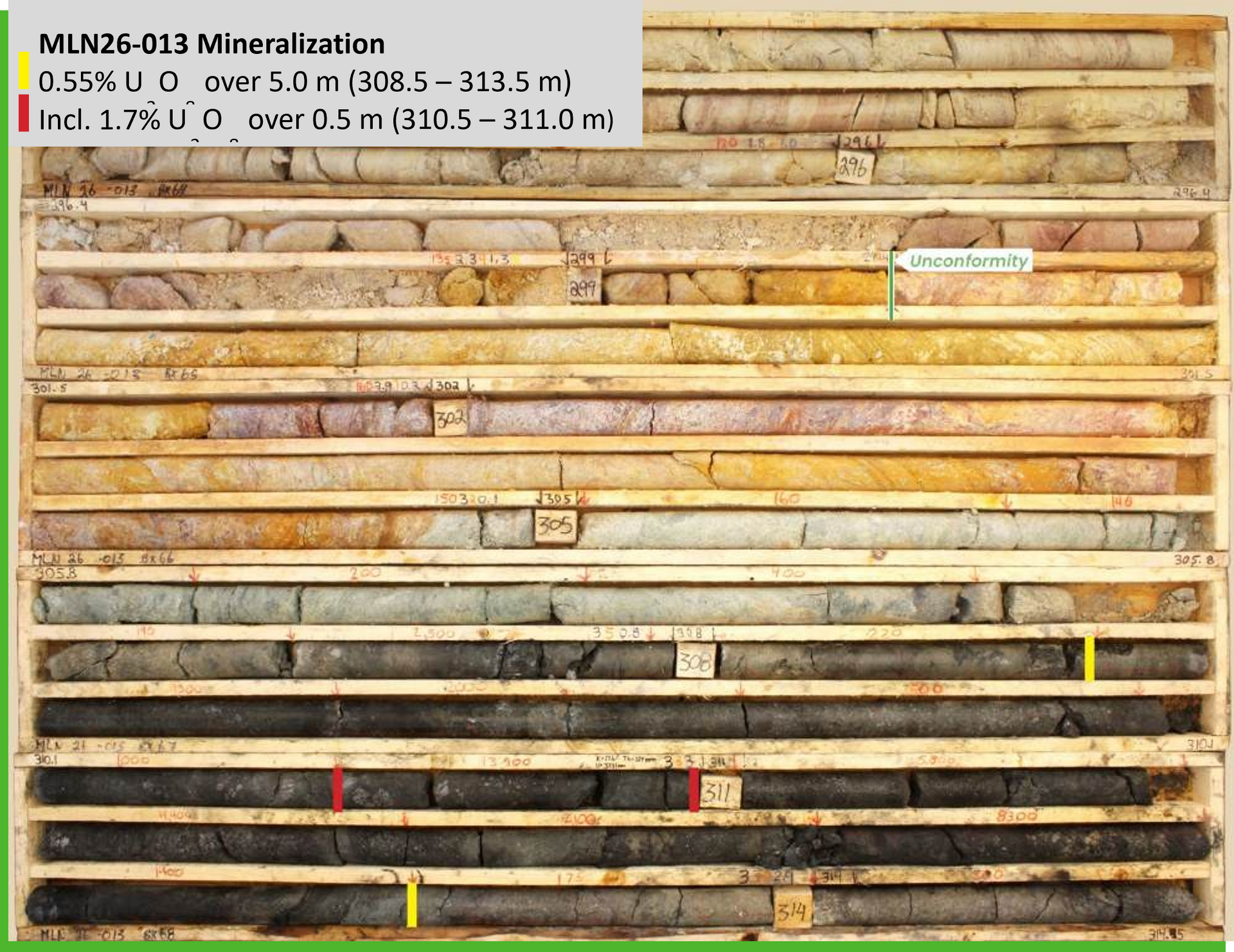
Chemical assays from MLN26-013 returned up to 1.7% U₃O₈ over 0.5 metres within 5.0 metres averaging 0.55% U₃O₈, with significant nickel and cobalt.
A fully partner-funded airborne radiometric and magnetic survey identified radiometric anomalies interpreted to relate to a potential uranium-bearing source near prospective basement features and upgraded Aurora to drill-ready status.
VANCOUVER, BRITISH COLUMBIA For investors evaluating an early-stage uranium stock, drill results are the primary evidence used to assess whether a mineral exploration company is advancing toward a potential discovery. Unlike producing companies, exploration companies derive much of their value from their potential to discover and advance significant mineral deposits. For investors, this means the opportunity for value creation is closely tied to exploration success, geological quality, and the potential scale of discoveries
Cosa Resources Corp. (TSX-V: COSA, OTCQB: COSAF, FSE: SSKU) (the “Company”) provides the following guide to interpreting uranium exploration results, using its Murphy Lake North Joint Venture in northern Saskatchewan as a practical example.
1. Why Drill Results Matter to an Early-Stage Uranium Stock
For an early-stage uranium stock, drill results are the primary evidence that a geological target is progressing from concept to verified mineral exploration potential.
At Murphy Lake North, Cosa Resources Corp. (the “Company”) advanced the Cyclone trend from an initial radioactive intersection to assay-confirmed uranium mineralization and then to an expanded follow-up program within a single year, providing a clear example of how exploration results can materially de-risk a target in Saskatchewan.
2. CPS Versus Chemical Assays: An Important Distinction
Counts Per Second (CPS) is a field radioactivity reading, while chemical assays are the laboratory results that quantify uranium grade and remain the definitive data point for interpretation.
For the Company, the distinction was illustrated when the March 24, 2026 reading of up to 13,900 CPS in MLN26-013 was confirmed on May 26, 2026 by assays of 5.0 metres averaging 0.55% U₃O₈, including 0.5 metres of 1.70% U₃O₈. The Company’s May 26, 2026 news release provides the complete assay and technical disclosure.
3. Grade and Thickness Must Be Read Together
Investors should read uranium grade and interval thickness together, because a stronger intersection is generally one that combines meaningful concentration with measurable width.
At Cyclone, the 1.70% U₃O₈ subinterval sits inside a broader 5.0-metre interval averaging 0.55% U₃O₈, and the 1.70% U₃O₈ result is orders of magnitude above typical global uranium head grades, making the interval notable in the context of uranium mining and uranium mines in Canada.
4. Why Alteration and Structure Are Leading Indicators
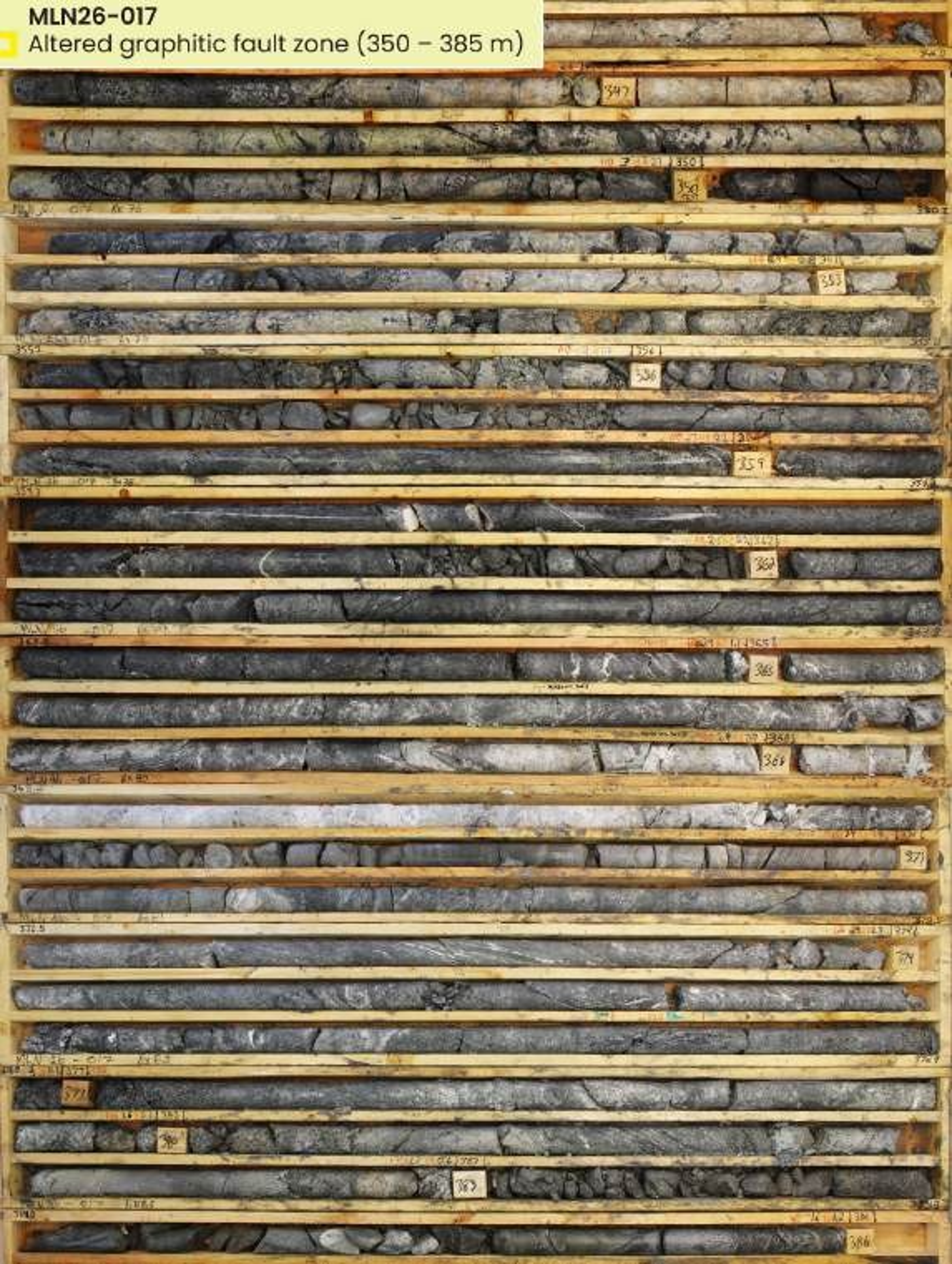
In Athabasca-style systems, alteration and structure are closely tracked because they can indicate the fluid pathways and trap sites associated with uranium deposition before assays define the full mineralized footprint.
At Murphy Lake North, all 13 holes in the 2026 summer program intersected moderate to strong alteration and/or structure across 650 metres of strike on the Cyclone trend, and the Company has stated that sandstone alteration patterns, basement lithologies and faulting are strikingly similar to the nearby Hurricane deposit.
5. How to Use Pathfinder Geochemistry
Pathfinder geochemistry helps determine whether a broader hydrothermal system is strengthening around a target; at Murphy Lake North, the Company uses uranium-in-sandstone thresholds of above 0.5 ppm as elevated, above 1.0 ppm as anomalous, and above 4.0 ppm as strongly anomalous.
The Company reported that MLN26-020C1 extended the pathfinder-enriched basement alteration zone 36 metres to the east, with similar nickel and cobalt enrichment, and that the zone remains open down dip and down plunge of MLN26-017.
6. What “Open Along Strike” Means
“Open along strike” means drilling has identified mineralization but has not yet closed off the system in one or both lateral directions.
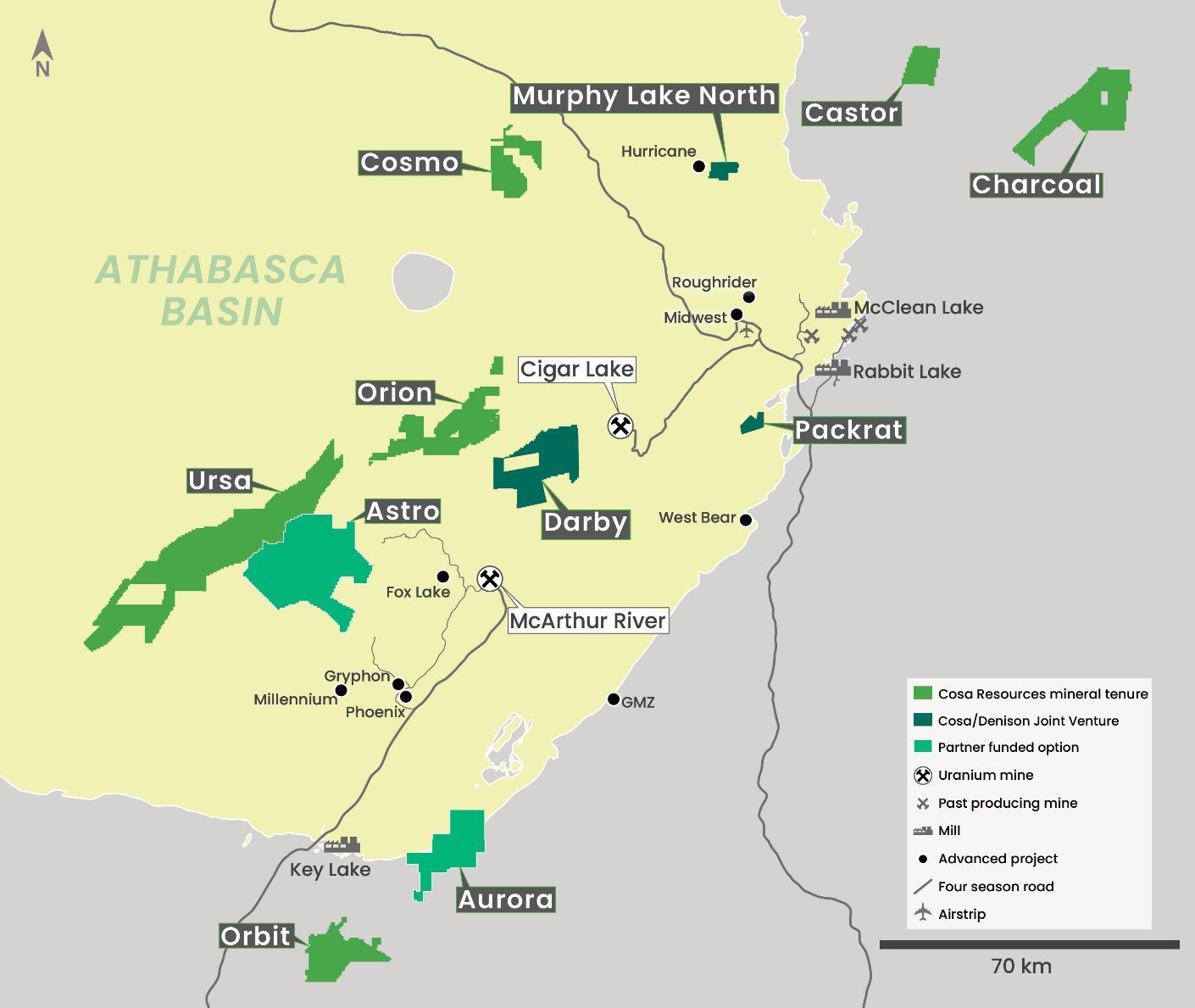
At Cyclone, the Company has reported that mineralization is open for at least 600 metres east and 600 metres west, while 13 holes totalling 6,752 metres have tested 650 metres of strike.
7. Why Nickel and Cobalt Matter
Nickel and cobalt can be important supporting indicators in Athabasca uranium systems when they occur with uranium, alteration and structure.
In MLN26-013, the 5.0-metre mineralized interval averaged 4.09% nickel and 1.73% cobalt, a polymetallic association the Company has described as consistent with Hurricane, Cigar Lake and Key Lake..
A Practical Investor Checklist
When reviewing any uranium drill result, investors should ask:
- Is the result based on CPS, chemical assays or both?
- What are the uranium grade and interval thickness?
- Is the higher-grade interval supported by broader mineralization?
- Are alteration, structure and pathfinder elements present?
- Is the system open along strike, down dip or down plunge?
- What is the next planned drill program, and has the disclosure been reviewed by a Qualified Person?
What Murphy Lake North Means for Cosa Resources
Cosa controls roughly 237,000 hectares across 100%-owned and joint venture projects in the Athabasca Basin, and Murphy Lake North is a 70/30 Cosa-operated joint venture with Denison Mines Corp. (TSX: DML, NYSE American: DNN) located approximately 2.7 kilometres east of the Hurricane deposit.
As stated by Keith Bodnarchuk, President and CEO, in the May 26, 2026 release:
“This is a significant result for Cosa, with the assays confirming that Cyclone hosts uranium mineralization comparable to discovery intersections from multiple Athabasca uranium deposits. The Cyclone trend is an extensive corridor of strong structure and alteration that now features uranium mineralization that is open along strike for 600 metres in both directions.”
Murphy Lake North is therefore emerging as an increasingly relevant asset for investors tracking uranium mining, uranium stock performance, and new uranium mines in Canada. Investors can learn more about Murphy Lake North, review the Company’s corporate information and subscribe for Cosa news updates.
About Cosa Resources Corp.
Cosa Resources is a Canadian uranium exploration company focused on discovering uranium deposits in northern Saskatchewan’s Athabasca Basin. The Company operates a portfolio of approximately 237,000 hectares across 100%-owned and joint venture projects, including strategic collaborations with Denison Mines. Cosa’s award-winning management team has a demonstrated record of uranium discovery and project advancement in the Athabasca Basin.
Technical Disclosure and Cautionary Statements
The technical information in this article was reviewed and approved by Andy Carmichael, P.Geo., Vice President, Exploration of Cosa Resources Corp., a Qualified Person as defined by National Instrument 43-101. CPS readings are total gamma measurements from an RS-125 handheld spectrometer and are indicators of uranium content only; they may not correlate with chemical assays. Samples from Murphy Lake North were submitted to SRC Geoanalytical Laboratories in Saskatoon, Saskatchewan for U₃O₈ assay and multielement analysis, and the Company employs standard QA/QC procedures including certified reference materials, blanks and standards.
References to neighbouring properties, including Hurricane, Cigar Lake and Key Lake, do not imply that mineralization on Cosa’s properties is comparable. Exploration results are not mineral resources or mineral reserves, and there can be no assurance that continued exploration will define an economically viable deposit.
This article contains forward-looking information, including statements regarding planned exploration, follow-up drilling, geological interpretation, mineralization potential and project advancement. Such information is based on assumptions considered reasonable as of the date hereof, but is subject to risks and uncertainties including financing, commodity prices, geological results, permitting, weather, access, contractor performance, supply-chain constraints, regulatory matters and joint venture obligations. Actual results may differ materially. Readers should not place undue reliance on forward-looking information. This article is for general information only and does not constitute investment, legal, tax or financial advice or an offer to buy or sell securities.